India’s beauty and wellness sector is large enough that what happens in its chairs is a labour story as much as a style one. A KPMG study for the Beauty & Wellness Sector Skill Council put the sector at more than ₹170,000 crore, up from about ₹90,000 crore in 2018, employing roughly 12.3 million people, 66% of them women, across more than a million outlets.
Note: Beauty & Wellness Sector Skill Council, Skill Gap Study, research by KPMG, 2023.
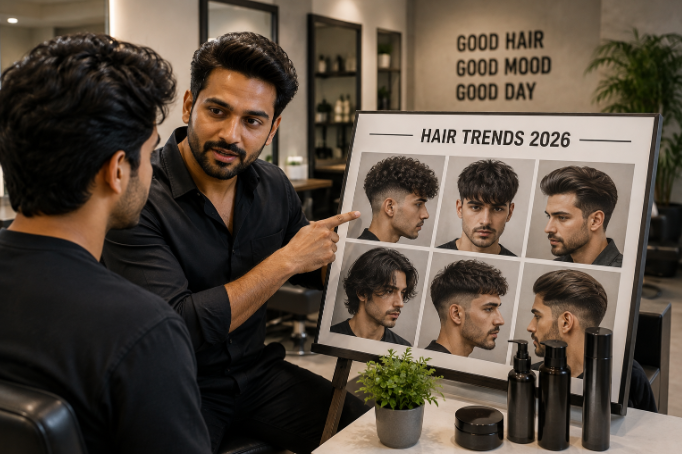
Vinay Kumar Nevatia, who runs a hair studio in Surat, reads the year from the photos clients bring to the chair rather than from any of that.
“Nobody walks in quoting a market report,” he says. “They walk in with a screenshot and a question about how often they’ll have to come back.”
That second half of the question is new, and he thinks it explains most of what people are calling a trend.
Lived-in colour, and an admission about the data
The clearest shift he sees is away from sharply defined, high-maintenance colour toward grown-out balayage and soft highlights.
He will not put a number on it. There is no research with disclosed methodology on Indian salon visit frequency, spend per visit, or demand for lower-maintenance colour. Everything available is paywalled syndicated market research or trend commentary without a sample.
“Every stylist you interview will tell you low-maintenance colour is up,” he says. “None of us can prove it. It’s what I see in my own diary and that’s all I’d claim.”
What he can say is why the appeal is structural rather than aesthetic. A regrowth line on a solid colour is visible in four weeks. A soft, diffused root is not visible at twelve. For a client budgeting salon visits, that difference is the whole decision.
It also changes what he does at the first appointment. A global colour is one decision. A lived-in one is a plan across three visits, and clients who are not told that in advance tend to read the first result as unfinished.
Vinay Kumar Nevatia on the bond-builder question
The treatment clients ask about most is the one where he departs from the industry line.
Bond builders are marketed as rebuilding broken disulfide bonds inside the hair. An independent Italian academic study using infrared and Raman spectroscopy plus SEM tested restoring treatments including bis-aminopropyl diglycol dimaleate and reported that none of the investigated treatments induced an increase in disulfide bridge content in the hair cortex, and that none of its results could be interpreted as direct evidence of the claimed cross-linking reaction. The same study did observe beneficial effects: a more regular hair surface and more imbricated cuticle scales.
Note: Di Foggia M et al., Int J Biological Macromolecules 2021, Università di Bologna, no industry affiliation.
“So they do something,” Nevatia says. “The cuticle looks better, the hair combs better, clients aren’t imagining it. What the independent work didn’t find is the bond repair on the label. I’d rather sell what it actually does.”
Newer work on experimental thiol cross-linkers has reported real improvements in mechanical properties and re-established disulfide bonds, but those are novel synthesised compounds in a lab, not the products sold at a salon counter.
Note: El Khatib S et al., Pharmaceuticals 2025.
He still uses them, and says so plainly. The distinction he draws is between a treatment that makes a service safer and smoother, which he believes, and a treatment that undoes damage, which he does not.
Why the healthy-hair trend is really a bleaching trend
The move toward hair health that stylists everywhere describe has a specific cause, and it is chemical lightening.
Research from AgResearch, a New Zealand government research institute with no beauty-industry ties, found protein loss increased with bleaching severity, that leached proteins included cortical intermediate filaments rather than just cuticle, that extensive melanin granule degradation was present even after the mildest bleach treatment, and that oxidation converted cystine disulphide bonds to cysteic acid. Its conclusion was that peroxide treatments quickly access the cortex, causing untargeted oxidative damage across the fibre.
Note: Grosvenor AJ et al., Int J Cosmetic Science 2018, AgResearch.
The phrase worth noticing there is “even after the mildest bleach treatment.” Damage is not a consequence of doing lightening badly. It is a consequence of doing it at all, and the craft lies in managing how much.
Separate work found bleaching increased hair permeability and released melanin granule contents into the fibre matrix, with diffused metal elements then promoting further damage catalytically with hydrogen peroxide.
Note: Imai T, Okajimas Folia Anatomica Japonica 2011. Author affiliated with a hair colour manufacturer.
This is why Nevatia turns work away.
“If someone comes in with hair that’s been lifted three times this year and wants platinum, the honest answer is no, or not yet,” he says. “That damage isn’t reversible. Conditioner hides it. Nothing undoes it.”
He estimates he declines or postpones a service most weeks, and says the conversation is easier when the reason is physical rather than aesthetic. Clients accept “your hair cannot take this yet” far better than “I don’t think it will suit you.”
Cuts built around a real morning
The other consistent request is for shapes that survive an ordinary weekday. Soft layers, movement, a fringe that can be pushed aside rather than one that requires a round brush and eleven minutes.
He treats this as a scheduling question rather than a style one. His working test is what a client will actually do on a Tuesday, not what they will do the morning after a salon visit.
“A cut that only works when I style it is a cut that fails six days out of seven,” he says. “That’s not the client failing. That’s me handing over something impractical.”
So the consultation includes questions that sound irrelevant. How long do you have in the morning. Do you tie it up by afternoon. Do you own a diffuser, and do you use it. The answers change the cut more than the reference photo does.
The market context worth being careful with
There is a wider commercial story, though it needs labelling. A Redseer and Peak XV analysis reported via IBEF projects India’s beauty and personal care market growing at about 10% between 2022 and 2027 to reach roughly US$30 billion, with Indian per-person spend at US$14 against US$313 in the US and US$38 in China.
Note: Redseer and Peak XV, via India Brand Equity Foundation. Covers beauty and personal care overall, not salon services alone.
That is a products-weighted number and says little about what happens in a chair in Surat. Nevatia mentions it only to note the direction of travel, and to point out that a growing market is not the same as a growing number of skilled stylists.
Where trend-following stops being useful
His limit is the screenshot itself. A reference photo shows a result on someone else’s hair density, texture, base colour and lifestyle, usually after professional styling and often after editing.
“Half the job is telling someone the photo is achievable and the other half is telling them it isn’t, or not without three appointments and damage they’ll regret,” he says. “The stylists who never say the second thing have very busy years and very unhappy clients.”
That is where Vinay Kumar Nevatia lands on 2026. The trends are real enough, but the useful conversation is about maintenance, condition and what a person will genuinely keep up.
About Vinay Kumar Nevatia
Vinay Kumar Nevatia runs a hair studio in Surat covering cuts by face shape, colour and everyday styling. More at.